Buyers used to ask how pure your metal is. The next question is where it came from and what it cost the planet.
A passport for things
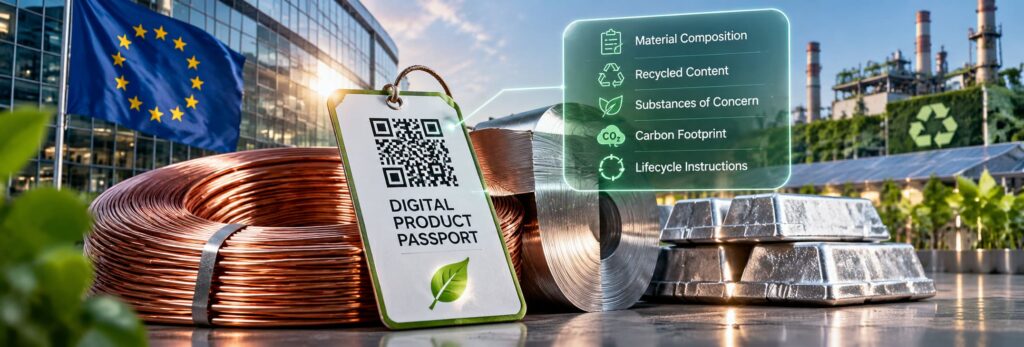
The EU’s Ecodesign for Sustainable Products Regulation (ESPR) entered into force in July 2024. Its centrepiece is the Digital Product Passport (DPP): a machine-readable record that travels with a product, reached through a data carrier such as a QR code. A passport can include material composition, recycled content, substances of concern, carbon footprint and lifecycle instructions.
There is no single start date. Each product group becomes subject to DPP rules when its own delegated act applies, on a calendar that runs through 2030 under the ESPR Working Plan 2025 to 2030.
Where metals sit on the calendar
Iron and steel come first: the Commission’s indicative timeline puts adoption of their delegated act in Q4 2026. Aluminium follows, with its delegated act expected in 2027. The central registry infrastructure was due in mid-2026. Separately, the Digital Battery Passport becomes mandatory for EV and industrial batteries from 18 February 2027, which lead supply chains should watch. All dates are indicative and may shift.
Copper is not named among the priority metals in the sources reviewed. That does not make it safe. Copper wire goes into motors, transformers and electronics, and buyers of those products will ask component suppliers for the data a passport needs.
Purity answers one question. Traceability answers four.
Purity says what is in the coil. Traceability says where the metal came from, how it was made, how much carbon it carries and how much of it is recycled. A manufacturer that already states it uses only LME-registered metal holds the first answer. The passport asks for the other three, in a form a system can read.
Build a passport-ready data pack
- Give every coil, spool and bundle a batch ID linked to its cast or production record and its metal supplier.
- Attach a certificate of analysis to each batch.
- Record the source: the LME-registered brand and the country of origin of the metal.
- Calculate and verify the carbon footprint per tonne.
- Declare recycled content as a percentage. Write zero if it is zero, because a blank looks like a gap.
- Keep RoHS declarations and substance data on file for every product.
- Print a QR code on the spool label that opens this record.
Purity is what is inside the bottle. Traceability is the label that proves it, and from 2027 onwards a regulator may read the label before the buyer reads the price.
Sources


Comments are closed